
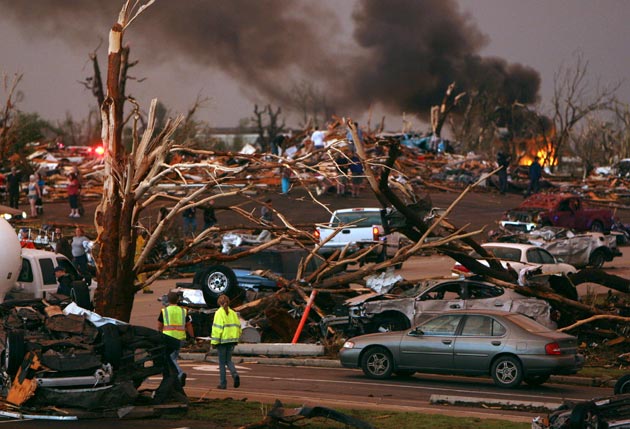
The lives lost this year from deadly storms and tornadoes is staggering. This year will no doubt go down, at least in my mind, as the year of the tornado. Approximately 505 people have been killed by this year’s deadly storms. That’s only 14 less than the record of 519 set in 1953.
In my last blog post, I analyzed the role that social media played during the devastating earthquake and tsunami in Japan. Given the level of success social media has achieved abroad during recent natural disasters, I was curious to see how connected and reliant parts of America are to social media outlets following a natural disaster.
Not surprisingly, parts of the country – in the wake of the recent twisters – are effectively utilizing and relying upon social media just like the bustling metropolis of Tokyo did after the earthquake. The connectivity was reliable and the volume of usage remains extremely high.
After the recent Joplin, Mo. tornado – which killed more than 130 people with many still missing – social media has proven, yet again, to be an effective tool in the wake of disaster. Blogger Kim Stephens might have put it best; social media has five key roles in disaster response and recovery.
First, it allows people to document the actual event – via messages, pictures, videos, etc. A recent Fast Company story about the Joplin tornado confirmed this belief by stating local impromptu journalists started filling the news void with posts on Facebook, Flickr, Twitter and YouTube, as local news media were overstretched and networks raced to the city.
Secondly, social media provides updates to family and friends that loved ones are safe. The Wichita Eagle reported people were posting on social media sites “that they and their families are OK.”The websites can also help start and facilitate the search for missing people. For example, the Tulsa World reported that someone posted, “There are people posting on FB [Facebook] that they are alive and wanting to be rescued from a trailer park behind Flying J near 32nd St. If anyone can reach them, they have no way out and no food or water.”
Additionally, social media sites can function as a resource on “where to get/give help,” as Stephens reports. Finally, the sites help affected residents recover lost items, such as family belongings, pets, company files and more. In Joplin, the St. John’s Regional Medical Center – which was destroyed by the EF-5 tornado (top winds of more than 200 mph) – is communicating via Facebook to retrieve scattered hospital files and data.
The bottom line is these sites continue to provide a real benefit to many – especially those dealing with the aftermath of devastating natural disasters.

 As a senior vice president at Cookerly, Matt helps organizations protect and advance their reputations and bottom lines through strategic communications programs. Using creativity, planning and flawless execution, he works with a team to deliver compelling public relations campaigns that produce results and support clients’ business objectives.
 As senior vice president at Cookerly, Mike Rieman specializes in building and maintaining relationships with the media and has an excellent track record of landing significant placements in print and broadcast media including USA Today, Wall Street Journal, Bloomberg and Money Magazine.
 As vice president of Cookerly, Sheryl Sellaway uses her extensive corporate communications background to lead consumer PR efforts, deliver strategy for marketing programs and share expertise about community initiatives.

Thanks for the mention.
Really enjoyed your column.